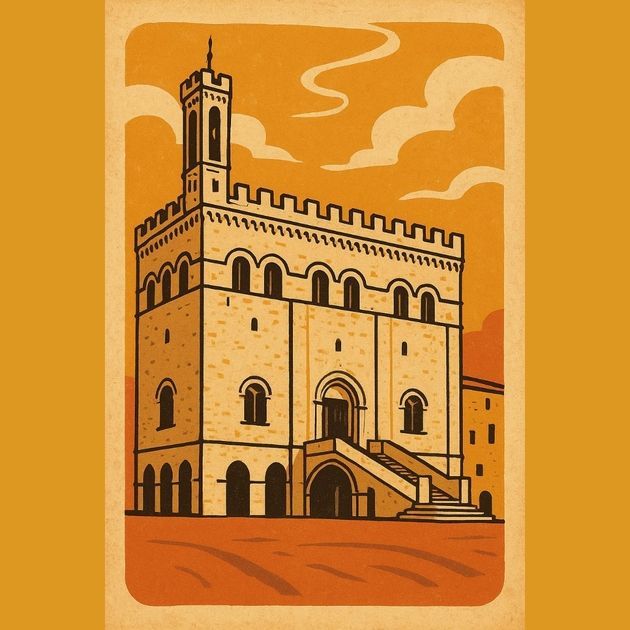


Holiday rental · Gubbio historic centre
Tailor-made itineraries:
discovering Gubbio and its secrets
Gubbio is a city that reveals itself slowly. With just one day you can admire its most famous monuments; with a few more days you can also explore the surrounding area, rich in medieval villages, natural landscapes, art, spirituality and gastronomic excellence. We have put together a series of itineraries to help you make the most of your stay.
Choose the length of your stay

The heart of medieval Gubbio
Perfect for those staying just one night — a plunge into the medieval heart of the city.
The day begins where Gubbio has its heart: Via dei Consoli. Walk slowly among the local craftsmen's workshops — lustred ceramics, wrought iron, hand-worked leather — and let the grey stone architecture make its impression before you even reach the square.
- Via dei Consoli — Starting point among the artisan workshops: lustred ceramics, wrought iron, hand-worked leather.
- Piazza Grande — One of the most extraordinary medieval squares in Italy: a terrace suspended over the valley, built on massive arches. It is worth pausing for a few minutes before going in, just to take it all in.
- Palazzo dei Consoli — Inside, two absolute rarities: the campanone (great bell), enormous and silent in its turret, and the Eugubine Tablets — seven bronze plates from the 2nd–1st century BC, the most important document ever found for the study of the ancient Umbrian language.
- Palazzo Ducale and Cathedral — A few steps further up, the Montefeltro palace closes the circle between the Middle Ages and the Renaissance. The building visually dialogues with the adjacent Cathedral: two different architectures, the same stone, the same light.
- Monte Ingino Cable Car — The small metal "cages" climb steeply to 827 metres. A memorable experience — not for those afraid of heights, but the panorama that opens up at the top is worth every moment of hesitation.
- Basilica of Sant'Ubaldo — It houses the relics of the patron saint and the three Ceri : wooden structures over five metres tall carried at a run on shoulders every 15th May. Seeing them up close helps you understand what the Festa dei Ceri truly is.
- Sunset aperitivo — Before heading down, the panorama over the valley turning orange is one of those moments you carry home with you.
Day 1 — The heart of medieval Gubbio — is unchanged. See the previous tab.

Ancient history, alleyways and traditions
For those dedicating a full weekend to the city.
- Roman Theatre — Dating from the 1st century BC, it is one of the best preserved in central Italy. Set in a quiet archaeological park, away from the main tourist flow: a place to sit on the steps and imagine the city as it once was.
- Church of San Francesco — Overlooking the historic market square, with a sober façade and interior rich in frescoes. It carries the story of the bond between Gubbio and Saint Francis — the same Francis who tamed the famous Wolf near the city.
- San Martino Quarter — The oldest and most picturesque in Gubbio: walk alongside the Camignano stream, among medieval houses, hanging gardens and silent alleyways that passing tourists rarely reach.
- Porta dei Morti(Door of the Dead) — A typical feature of medieval Eugubine houses: narrow, raised openings, separate from the main door. Their exact function is still debated among historians.
- Local craftsmanship — Gubbio's metallic lustre ceramics are a Renaissance technique brought back to life by a few local masters. Alongside this, wrought iron and leather work: living craftsmanship, not folklore.
Days 1 and 2 are unchanged. See the previous tabs.

Nature, trekking and the "Certificate of Madness"
Switch off with an active experience and a uniquely Eugubine ritual.
- Bottaccione Gorge — A few minutes' walk from the historic centre: a cleft in the rock carved by a stream, running alongside a still-standing medieval aqueduct. It was here that physicist Luis Alvarez found in the 1980s the first evidence of the meteorite impact that caused the extinction of the dinosaurs — a discovery that changed palaeontology worldwide.
- The walk is straightforward and suitable for everyone: a well-marked path, vegetation that changes colour with the seasons. In autumn it is of an unexpected beauty.
- Fontana del Bargello — Three laps running around the fountain and you receive the symbolic Certificate of Madness of Gubbio. A moment of genuine lightheartedness that stays with you for a long time.
- Civic Museum or relaxation — The Civic Museum in Palazzo dei Consoli deepens everything seen in the previous days. Alternatively, a historic café in the centre and Gubbio flowing by.
Days 1, 2 and 3 are unchanged. See the previous tabs.

Day trips — the heart of Umbria
Use Gubbio as a strategic base for exploring the region.
The largest lake in central Italy. Ferry to the Isola Maggiore — a fishing village almost unchanged over time — or the wilder Isola Polvese. Afternoon in Castiglione del Lago with its medieval fortress overlooking the water. Recommended in spring and summer.
Francis unites Gubbio and Assisi: the story of the Wolf is still alive in both cities. The Basilica of San Francesco — frescoed by Cimabue and Giotto — is one of the most visited monuments in Italy, yet it still manages to surprise. The upper town deserves a slow afternoon walk.
Days 1–4 are unchanged. See the previous tabs.

On the road — Monte Cucco
For those who love unspoilt nature and breathtaking panoramas.
- Monte Cucco Regional Park — Beech forests, high-altitude meadows, rocky ridges and one of the deepest cave systems in Italy. About 30 minutes from Gubbio: a completely different world from the medieval city, yet part of the same territory.
- Monte Cucco Caves — Guided tour into the heart of the mountain through tunnels, chambers and limestone formations built up over millennia. Duration approx. 1h 30min. Guided visits only.
- Val di Ranco and Pian delle Macinare — For those who prefer to stay outdoors: a slow lunch on the high-altitude meadows with crescia eugubina flatbread, local cured meats and cheeses, watching hang gliders glide silently overhead.
Choose your travel style
Gubbio has something for every type of traveller. Find the experiences that suit you best.
If you love history
Three thousand years of civilisation — Umbrian, Roman, medieval and Renaissance — preserved in a historic centre that has remained almost intact.
If you travel with children
Concrete and engaging experiences: the cable car, the park, the Certificate of Madness. Gubbio surprises children as much as adults — perhaps even more.
If you love photography
Gubbio's light changes with the hours and seasons in ways that surprise every time. Bring more memory cards than you think you'll need.
If you love good food
Eugubine cuisine is generous, deeply rooted in the land and still largely unspoiled by mass tourism. Great news for those who eat with curiosity.
If you are a pilgrim
Gubbio is a city of ancient faith. The presence of Saint Francis — and the story of the Wolf — binds it forever to Umbrian spirituality.
If you enjoy trekking
Five routes mapped and downloadable on Komoot, suitable for different levels. From the easy Bottaccione to the challenging Coppo Madonna del Sasso.
Trekking routes
Five routes mapped with Komoot, ready to download. Click on each one to read the description and view the interactive map.
A loop route starting from the historic centre, climbing towards the Sant'Ubaldo Gate — one of the most evocative medieval entrances to the city — and returning past the Palazzo dei Consoli with views over the medieval aqueduct of the Bottaccione Gorge. Well-marked path, suitable for all. Ideal for those who want to walk without missing the main monuments.
The most complete route for those wanting to combine a visit to the historic centre with a real high-altitude hike. Starting from the lower city, passing through medieval alleyways, climbing to the Rocca and Monte d'Ansciano, reaching the Sant'Ubaldo Gate and returning via the Palazzo Ducale and the Hanging Gardens. Good physical fitness recommended for the elevation gain.
The most adventurous route. Starting from the Coppo Park, descending through a forest path to the small Chapel of the Madonna del Sasso — a hidden gem beside a stream — and climbing back up past Gubbio's monumental cemetery. One section crosses technical terrain: trekking boots with good grip and a minimum of hiking experience are required.
Short but demanding in terms of elevation: 300 metres of altitude gain in less than 2.5 km on a well-marked dirt path. It is the walking alternative to the cable car for those who want to earn the panorama with their own legs. On the way down you can take the cable car to vary the experience.
The most family-friendly route and ideal for those wanting an easy walk with extraordinary scientific and scenic content. Walk along the Bottaccione Gorge to the water basin, following the medieval aqueduct and the famous geological strata linked to the theory of dinosaur extinction. Easy path, mostly on compact natural ground. Suitable for children wearing sturdy trainers.